


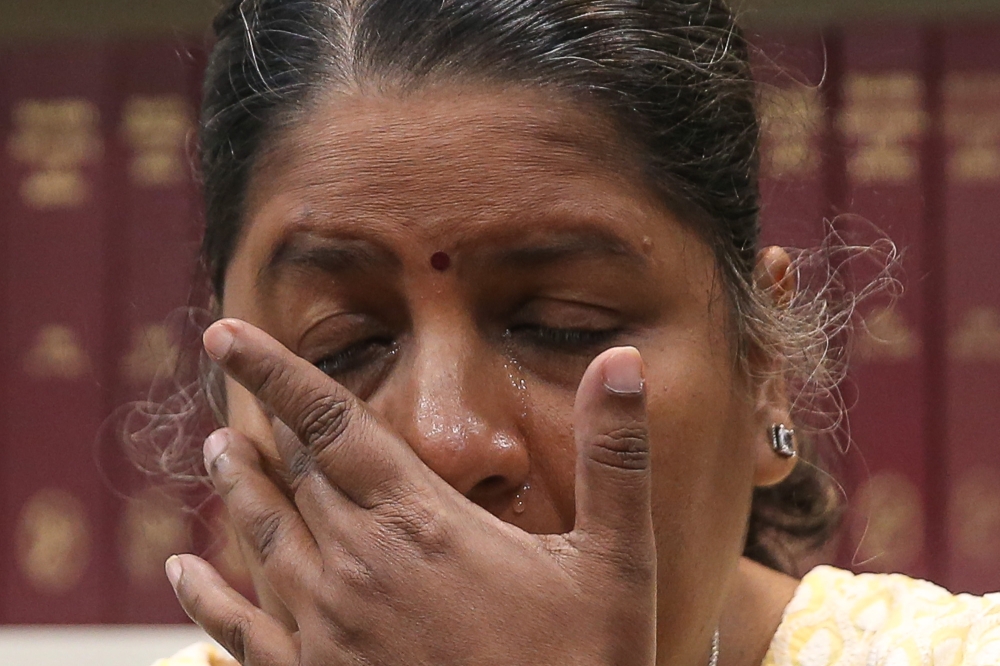
KUALA LUMPUR, June 12 — The High Court today dismissed a challenge by Ipoh mother M. Indira Gandhi and 13 others against state laws that allow children under age 18 to be converted to Islam without both parents’ consent.
Court of Appeal judge Datuk Aliza Sulaiman, who was a High Court judge when this case was heard, said that all 14 of them had failed to show they have locus standi, meaning the legal standing, to pursue this court challenge.
The judge also said they had failed to show that they have a “real or genuine interest” in this matter.
But as this court challenge was filed as a public interest matter, the judge did not order Indira and the 13 others to pay for legal costs.
Indira and the 13 others had wanted the courts to declare that the practice of unilateral conversion is unconstitutional, and to declare that provisions in several state laws allowing unilateral conversion to Islam are invalid or have no legal effect.
To be precise, their challenge was against provisions in six state laws in six states (Perlis, Kedah, Melaka, Negeri Sembilan, Perak and Johor) and a similar law for the Federal Territories (Kuala Lumpur, Putrajaya and Labuan), which allowed those under age 18 to be converted to Islam with just one parent’s consent.
Indira and 13 others had filed the constitutional challenge against six state governments (for Perlis, Kedah, Melaka, Negeri Sembilan, Perak and Johor) and the federal government of Malaysia (on behalf of the Federal Territories).
Two state religious bodies, the Federal Territories Islamic Religious Council (MAIWP) and the Johor Islamic Religious Council (MAIJ), were later allowed to join the court case as interveners.
Here’s why the High Court in Kuala Lumpur dismissed the challenge
In reading out the brief grounds of her judgment, Aliza noted that 14 plaintiffs had argued that they have sufficient links to these state laws which allow unilateral child conversion, due to reasons such as direct experience with unilateral conversion, living in these states, or holding positions in organisations that protect and promote the welfare of Hindu or other non-Muslim communities.
The plaintiffs had also argued they have a “real and genuine interest” in whether these state laws are constitutional and continue to operate, as it could affect them in the future.
The plaintiffs had cited the Federal Court’s 2024 decision in Nik Elin Zurina Nik Abdul Rashid’s constitutional challenge, where the court said “locus standi” or legal standing should be relaxed to allow any “public-spirited” person to file a public law suit in court if he has “some interest” in the matter.
But the judge disagreed that the 14 plaintiffs had legal standing for this court challenge.
“In my considered view, the plaintiffs have not established they have a real or genuine interest in seeking the declaratory orders sought. And even if the bar is lowered and they are taken as public-spirited, I’m unable to say they have some interest in the matter,” the judge said during online court proceedings in a Zoom session this afternoon.
The judge gave a detailed list of reasons:
Plaintiff 1, Indira
Indira’s ex-husband had unilaterally converted their three children to Islam in 2009 without her knowledge, before she succeeded in 2018 at the Federal Court to quash those conversions.
The judge said Indira’s interest in this case is “purely academic”, as any grievances that she had have been conclusively dealt with by the Federal Court in the January 29, 2018 decision which quashed the unilateral conversion of her three children.
Plaintiffs 2 to 4
- S. Mohan (former president of both Malaysia Hindu Sangam and Malaysian Consultative Council of Buddhism, Christianity, Hinduism, Sikhism and Taoism (MCCBCHST);
- Arumugam Dorasamy (chairs the Indira Gandhi Action Team (I.N.G.A.T), former Malaysia Hindu Sangam youth leader;
- Pertubuhan Hindu Agamam Ani Malaysia (which deals with the Hindu community’s social welfare).
The judge said there is no evidence in any affidavits to show they are office-bearers or representatives of the various religious community groups or that they had been given the authority by the groups to file this court challenge.
Plaintiffs 5 to 12
- Eight Malaysians, each living in Perlis, Kedah, Melaka, Negeri Sembilan, Pahang, Perak, Johor and Kuala Lumpur.
The judge said there was no evidence shown that these eight persons have any children who are below the age of 18 and may be affected by the state laws: “There interest is merely hypothetical or academic.”
Among other things, the judge noted that the Kedah and Negeri Sembilan state governments have argued that Plaintiff 6 and Plaintiff 8 had never been converted to Islam, and that the state laws being challenged do not apply to them even though they have residential addresses in those two respective states.
Plaintiffs 13 and 14
- Two women (identified only as “A” and “M” for privacy reasons) who say they had been unilaterally converted by one of their parents at age nine and 10 in Johor, but assert that they practise Hinduism instead of Islam.
Since the 14 plaintiffs are asking for a court declaration that any unilateral conversion of children that took place after the Federal Court’s 2018 decision in Indira’s case is invalid, the judge said Plaintiffs 13 and 14 do not have “any interest” in this case as their alleged conversions took place before the Federal Court’s 2018 decision.
The judge agreed with both the Johor state government and the Johor Islamic Religious Council (MAIJ) that these two women are now adults and are free to “renounce their Islamic faith by filing appropriate applications or initiate whatever action they see fit”.
She said there was also no evidence shown that these two women have children below the age of 18 who could be affected by any of the state laws in this case.
Other points by the judge
Citing a Federal Court decision in 2020, the judge also said the case today is not a “rare and exceptional” case which would enable someone to challenge a potentially unconstitutional law just because it exists and without having to wait for the law to be used against the person.
In today’s case, the plaintiffs had wanted the court to give an order that would amount to a “blanket reversal” of unilateral child conversions that took place after the 2018 Indira decision.
Among other things, the judge said the federal government of Malaysia had “correctly” argued that the Federal Court’s 2018 decision in Indira’s case had never declared Section 106 of the Administration of The Religion of Islam (Perak) Enactment 2004, the Perak state law which enables unilateral conversion, as unconstitutional.
The judge also agreed with the Malaysian government’s argument that the 2018 Indira decision did not declare other similar state laws which enable unilateral conversion, being challenged in this court, as unconstitutional.
The judge said the Malaysian government had also “aptly” argued that the “litmus test of mutual parental consent”, or having both parents’ consent in the 2018 Indira decision, cannot be applied to all child conversion cases, as it “oversimplifies the complicated concept of welfare of children and undermines the significance of the best interests of the children”.
The judge also quoted the Malaysian government’s argument that the best interests of children should be assessed on a case-by-case basis, as it could be affected by an infinite number of factors.
The Kedah, Melaka, Negeri Sembilan and Johor state governments today asked for RM10,000 costs each, while MAIWP and MAIJ asked for RM50,000 and RM20,000 costs respectively, while the rest did not seek costs.
But after hearing the 14 plaintiffs’ lawyer Amanda Sonia Mathew’s argument that this is a public interest case, the judge agreed and did not make any court order for costs to be paid.
Recommended reading: